Productionworkflow in Modern Web-to-Print Operations

A scalable Produktionsworkflow is the backbone of successful web-to-print operations. printQ connects ordering, personalization, preflight, and production into one automated flow for B2B and B2C. Built on Adobe Commerce, printQ enables lights-out workflows that reduce manual effort while increasing speed, quality, and scalability.
Why the Productionworkflow Defines Success in Web-to-Print
Web-to-print is often discussed from the storefront perspective. Product configurators, editors, and ordering experiences dominate conversations. Yet the real bottleneck usually appears after the order is placed. Files must be checked, data prepared, jobs routed, and production systems supplied with clean, structured information.
This is where the Productionworkflow becomes decisive. It determines whether web-to-print creates efficiency or simply shifts complexity downstream. A weak workflow forces teams to intervene manually. A strong workflow enables scale without proportional growth in effort.
printQ is designed around this principle. It treats production workflow as a first-class system component, not as an afterthought.
From Online Order to Production-Ready Job
In printQ, the Produktionsworkflow begins the moment an order is created. The system does not treat production as a separate phase handled by another tool. Instead, it connects commerce logic, personalization data, and production requirements into one continuous flow.
Orders are enriched with all relevant metadata. Product configuration, finishing options, quantities, delivery requirements, and customer-specific rules are structured from the start. This creates a reliable foundation for automation.
Core concept: production readiness starts at the storefront, not in prepress.
printQ Positioning: Production-Centric Web-to-Print
printQ is a premium web-to-print platform built for environments where production efficiency matters as much as sales. It supports B2B and B2C storefronts while maintaining a production-first mindset.
Unlike lightweight tools that focus on order capture, printQ embeds production logic into the platform. This ensures that what is sold online can be produced efficiently, repeatedly, and at scale.
This positioning is particularly relevant for professional print service providers, agencies with fulfillment responsibility, and enterprises with internal production workflows.
Adobe Commerce as the Workflow Foundation
The Produktionsworkflow in printQ is built on Adobe Magento also called Adobe Commerce. This matters because production automation depends on reliable commerce data.
Adobe Commerce provides mature order management, customer structures, pricing logic, and extensibility. printQ builds on this foundation to ensure that production workflows are driven by consistent and validated data.
For IT and operations teams, this means fewer exceptions and clearer system boundaries.

SaaS or On-Premise: Workflow Control by Design
Different organizations have different requirements for production control. printQ supports both SaaS and on-premise deployments.
In SaaS environments, workflows benefit from standardized updates and managed infrastructure. On-premise setups allow deeper customization and tighter integration with internal production systems.
Operational takeaway: the Produktionsworkflow adapts to governance needs, not the other way around.
Preflight as a Core Workflow Component
Preflight is one of the most critical steps in any print workflow. In many organizations, it remains heavily manual. printQ changes this by embedding automated preflight directly into the Produktionsworkflow.
Automated File Validation
Files are checked against defined rules as soon as they enter the system. Resolution, color spaces, formats, and structural requirements are validated automatically.
This prevents problematic jobs from reaching production and reduces costly rework.
Early Error Detection
By shifting checks upstream, issues are resolved when they are cheapest to fix. Customers receive immediate feedback, and internal teams avoid firefighting later.
Result: higher throughput with fewer interruptions.
The Role of the Online Editor in Production Readiness
The online editor is not just a design tool. In printQ, it is an integral part of the Produktionsworkflow.
WYSIWYG with Production Awareness
The editor reflects real production constraints. Formats, folds, and finishing options are represented accurately in 2D and 3D previews.
This alignment ensures that what customers see is what production receives.
Structured Output Instead of Flat Files
Instead of generating opaque files that require interpretation, printQ produces structured output. This makes downstream automation more reliable and predictable.
Key benefit: less manual interpretation in prepress.
Templates and CI Control in the Workflow
Templates play a central role in scalable production workflows. They define what can change and what must remain fixed.
printQ’s template system ensures that personalization does not break production standards. Critical elements are locked, while variable areas allow controlled customization.
This approach is especially valuable in environments with repeat orders, distributed users, or strict brand requirements.
Variable Data Printing as a Workflow Driver
Variable Data Printing is not just a marketing feature. It is a workflow challenge.
printQ integrates VDP deeply into the Produktionsworkflow. Data sets are processed systematically, validated automatically, and merged into production-ready outputs.
This allows high-volume personalization without manual data handling.
Practical impact: personalization scales without slowing production.
Mobile Uploads and Distributed Data Sources
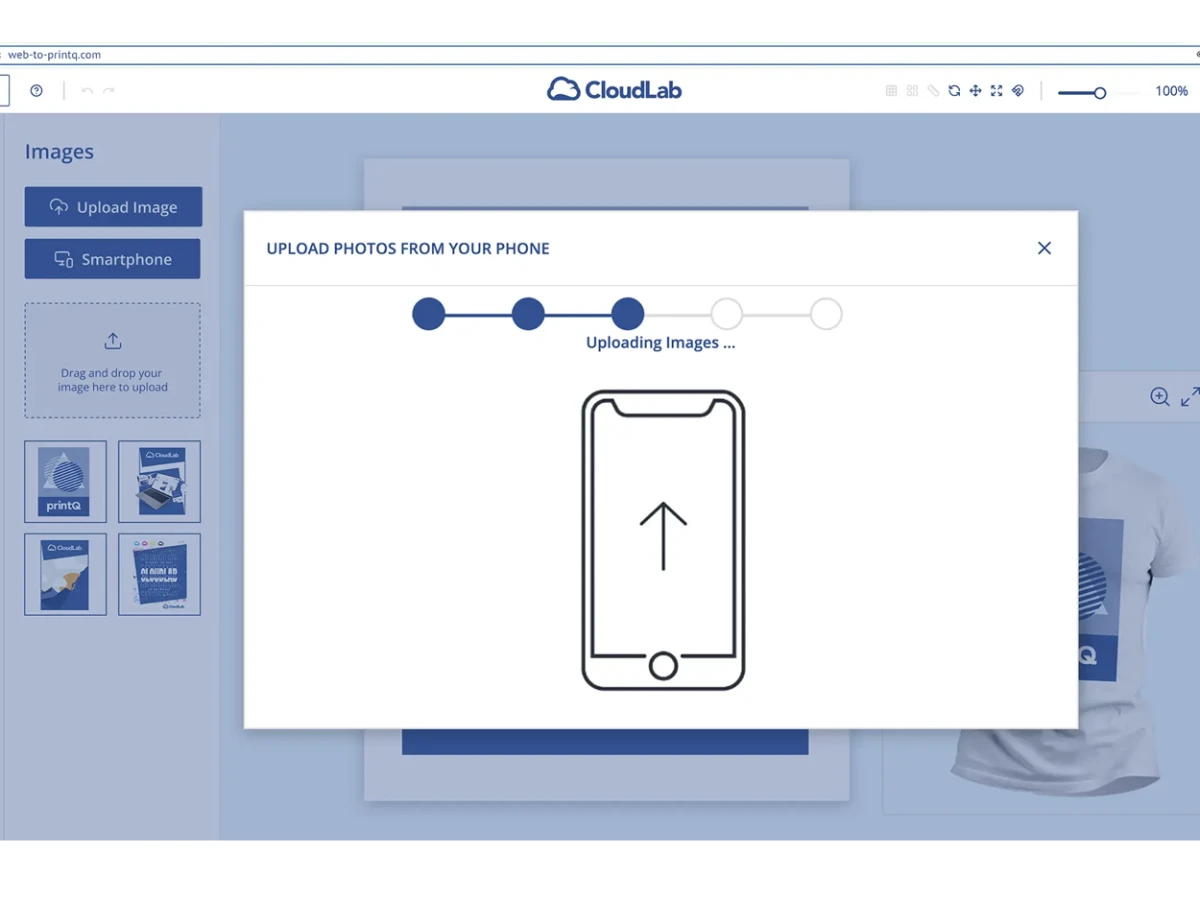
Modern production workflows must handle input from many sources. printQ supports mobile uploads via QR codes and structured data handovers.
This enables decentralized teams to contribute content while the system enforces production rules centrally.
The workflow remains consistent even when input is distributed.
Lights-Out Production Workflows Explained
The term “lights-out” describes workflows that run with minimal human intervention. In printQ, this is not a buzzword but a design goal.
End-to-End Automation
Orders move from storefront to production systems without manual re-entry. Job data, files, and metadata are generated consistently.
This reduces dependency on individual expertise and improves operational resilience.
Predictable Throughput
Automated workflows create predictable processing times. This supports better capacity planning and delivery reliability.
Business value: scale without scaling chaos.
Open Integrations in the Productionworkflow
Production workflows rarely exist in isolation. They must connect to ERP, MIS, finishing equipment, and logistics systems.
printQ supports open integrations using REST, SOAP, XML, JDF, CSV, and JSON. This allows production workflows to fit into existing IT landscapes.
ERP and MIS Connectivity
Orders and production data can flow directly into ERP or MIS systems. This reduces duplicate data entry and improves transparency.
Headless Workflow Extensions
For advanced scenarios, headless approaches allow custom orchestration layers while keeping printQ as the workflow core.
Strategic advantage: flexibility without lock-in.
Scaling the Productionworkflow Across Multiple Portals
As businesses grow, workflows must scale horizontally. printQ supports multi-client environments where dozens or hundreds of portals share the same production backbone.
Each portal can have its own rules, templates, and customer structures. The Produktionsworkflow remains consistent and centrally managed.
This prevents fragmentation and simplifies operations at scale.
Who Benefits Most from an Automated Productionworkflow
Print Service Providers
Printers benefit from reduced manual handling and faster turnaround times. Repeat orders become predictable and efficient.
This improves margins and frees capacity for higher-value work.
Agencies with Fulfillment Responsibility
Agencies managing print production need reliable workflows. printQ ensures that customization does not compromise production quality.
White-label setups benefit from standardized workflows across clients.
Enterprises and Franchise Organizations
Enterprises require governance, approvals, and consistency. Franchises require speed and local adaptation.
printQ’s Produktionsworkflow supports both through structured automation.
USPs That Matter for Production Efficiency
Several characteristics make printQ’s Produktionsworkflow stand out.
Adobe Commerce integration: reliable order data as workflow input.
Automated preflight: fewer errors, earlier validation.
End-to-end automation: reduced manual touchpoints.
API-first architecture: integration without bottlenecks.
Multi-client scalability: one workflow, many portals.
These factors directly influence daily production performance.
Mini Workflow Scenarios from the Field
High-Volume Commercial Printing
In high-volume environments, even small inefficiencies multiply. Automated preflight and job routing stabilize throughput.
printQ helps maintain speed without sacrificing quality.
CI-Driven Repeat Orders
When customers reorder frequently, consistency matters. Templates and structured workflows reduce setup time to near zero.
Production becomes repeatable instead of reactive.
Enterprise Procurement Portals
Enterprise portals require approvals, budgets, and compliance. printQ integrates these steps into the workflow without slowing production.
Outcome: control and efficiency coexist.
Productionworkflow as a Competitive Advantage
An optimized Produktionsworkflow is not just an internal efficiency tool. It becomes a market differentiator.
Faster turnaround, fewer errors, and reliable personalization improve customer satisfaction and retention. Over time, this operational excellence translates into growth.
printQ enables this by treating production workflow as strategic infrastructure.
Productionworkflow
A scalable Productionworkflow is essential for modern web-to-print operations. printQ delivers end-to-end automation from order to production, combining Adobe Commerce, automated preflight, structured data, and open integrations. The result is a workflow that reduces manual effort, increases reliability, and supports growth across B2B and B2C environments.
So a robust Productionworkflow is the key to scaling web-to-print successfully. printQ connects ordering, personalization, automated preflight, and production into one end-to-end flow. Built on Adobe Commerce and designed for SaaS or on-premise use, printQ enables lights-out workflows, open integrations, and multi-client scalability. For print businesses, agencies, and enterprises, printQ turns production from a bottleneck into a competitive advantage.