Web to Print Trends for Modern Print Businesses

Web to print is reshaping how print businesses sell, produce, and scale. Modern web to print solutions like printQ combine storefronts, online editors, and full workflow automation in one Magento-based system. From B2C shops to complex B2B portals, printQ enables end-to-end automation, API-driven integrations, and scalable multi-client environments. The result: faster turnaround, lower costs, and new digital revenue streams.
Web to Print: Trends and Future Web-to-Print Solutions for Print Businesses
Web to print has evolved from a simple online ordering tool into a strategic backbone for modern print businesses. What once started as a digital front door for business cards and flyers is now a fully integrated commerce and production ecosystem.
Today’s customers expect more than an upload button. They want live previews, personalization, seamless checkout, and rapid delivery. At the same time, print providers need automation, ERP connectivity, and scalable infrastructures that support both B2C and B2B business models.
This is exactly where premium web to print solutions such as printQ redefine what is possible.
The Strategic Shift: Why Web to Print Is No Longer Optional
The print industry has fundamentally changed. Buyers are digital. Processes must be automated. Margins depend on operational efficiency.
Digital-first expectations: Customers expect 24/7 access, real-time pricing, and immediate design feedback. Without web to print, a print business quickly appears outdated.
Operational pressure: Manual prepress checks, email-based approvals, and spreadsheet-driven order management are too slow and error-prone.
Scalability requirements: Growth means handling higher order volumes without increasing headcount proportionally.
Web to print is no longer a “nice-to-have.” It is infrastructure.
What Modern Web to Print Solutions Must Deliver
Not every web to print system meets enterprise requirements. Modern platforms must combine storefront, production logic, and backend integration.
A future-ready solution includes:
- Unified B2C and B2B storefront architecture
- Live WYSIWYG online editor with 2D/3D preview
- Template management and variable data printing
- Automated preflight and production-ready PDF output
- Open APIs for ERP, MIS, and third-party systems
printQ was built precisely around these requirements.
printQ: Premium Web to Print on Adobe Commerce
printQ is not a plugin layered onto a basic shop. It is the only web to print solution built natively on Adobe Commerce (Magento). That matters.
Deep e-commerce integration: Magento provides enterprise-level commerce features — customer accounts, pricing rules, tax logic, shipping modules, and payment integrations — out of the box.
Flexibility in deployment: printQ can run as SaaS (cloud-hosted) or on-premise. This flexibility supports both agile startups and established enterprise environments with strict IT governance.
Headless architecture: Frontend and backend are decoupled. Businesses can build custom frontends while maintaining the powerful printQ core.
This architectural depth differentiates printQ from closed SaaS tools that limit customization.
B2C Web to Print Storefronts: High-Converting Online Shops
For print businesses targeting end customers, conversion performance is critical.
A modern B2C web to print storefront must:
- Allow intuitive product configuration.
- Provide transparent pricing in real time.
- Offer seamless checkout and payment integration.
- Deliver instant design previews.
printQ integrates all of this within Magento’s commerce framework.
Customers can customize products visually through the WYSIWYG editor. The system generates production-ready files automatically. No manual intervention is required for standard jobs.
This “lights-out” workflow significantly reduces operational overhead.
B2B Web to Print: Closed Portals with Control and Efficiency
B2B web to print environments are more complex.
Corporate clients need:
- Role-based access rights.
- Approval workflows.
- Individual pricing structures.
- CI-compliant templates.
printQ enables both open shops and closed portals in one system.
A company with decentralized branches — for example, franchise networks, banks, or retail chains — can operate centralized brand portals. Local users personalize materials within predefined boundaries. Headquarters retains brand control.
This is where web to print b2b becomes strategic rather than transactional.
Online Editor: Usability Meets Production Precision
The heart of any web to print software is its online editor.
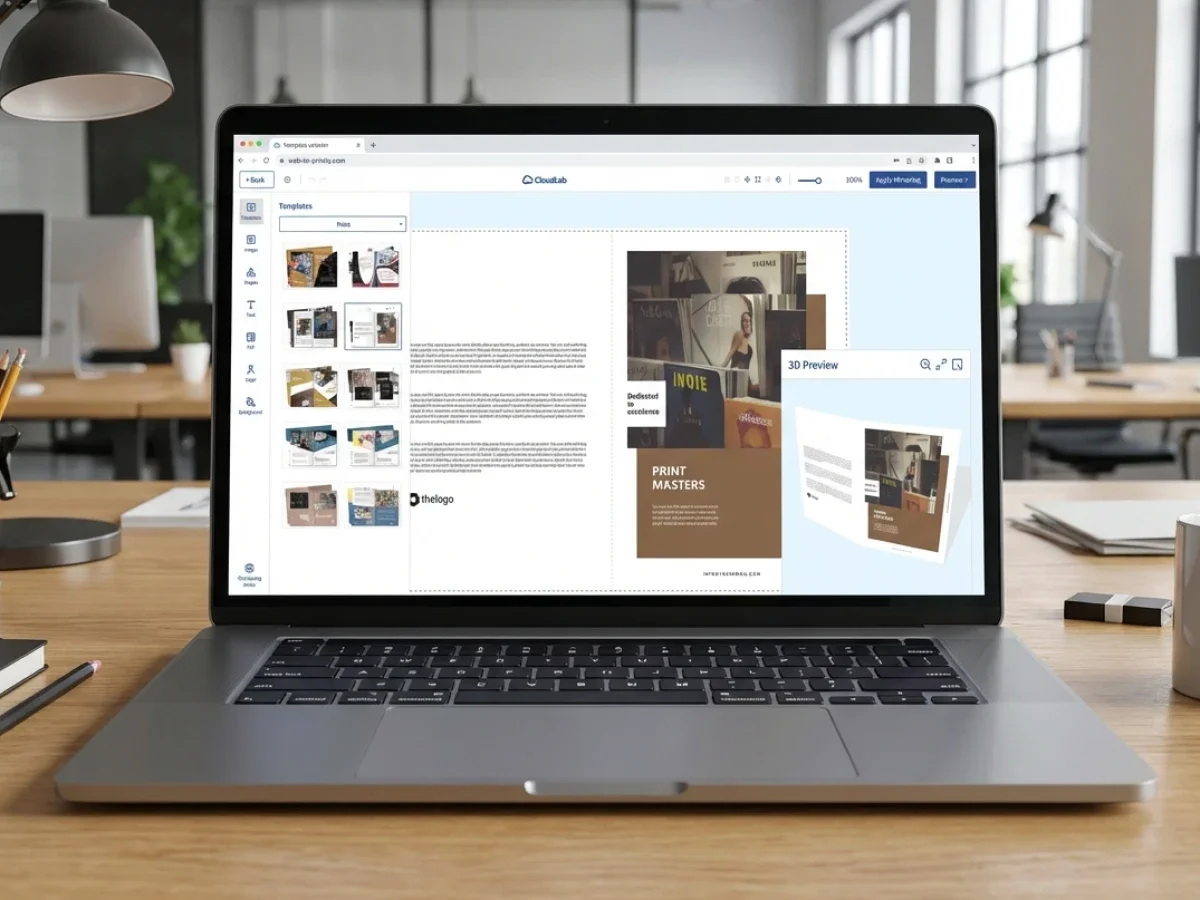
printQ offers a browser-based WYSIWYG editor with:
- Real-time 2D and 3D previews.
- Automatic vectorization.
- Finishing simulation (e.g., embossing, varnish).
- Dynamic layout alignment tools.
Customers see exactly what they will receive. What-you-see-is-what-you-get is not marketing language — it is operational risk reduction.
For packaging and complex products, interactive 3D previews provide clarity that static mockups simply cannot deliver.
Template Gallery and Variable Data Printing
Mass customization is one of the most powerful growth drivers in print.
printQ includes a comprehensive template gallery. Print providers can upload professionally designed templates for business cards, brochures, labels, and more.
Customers select a template and personalize it.
Variable Data Printing (VDP) enables large-scale personalization — names, addresses, codes, or localized offers — without manual adjustments.
This allows:
- Franchise chains to generate location-specific marketing.
- HR departments to create personalized onboarding materials.
- Event organizers to print unique badges in bulk.
Scalability without complexity — that is the promise.
Automation and Preflight: From Click to Press Without Bottlenecks
Manual prepress is expensive.
printQ integrates automated preflight checks and production-ready PDF generation. Files include bleed, color profiles, and cut marks automatically.
Orders flow directly into production systems via API or file-based interfaces such as XML, JDF, CSV, or JSON.
This results in:
- Fewer errors.
- Faster turnaround.
- Lower staffing costs.
- Higher production predictability.
Routine orders truly run lights-out.
API-First and ERP/MIS Integration
Modern print operations rely on interconnected systems.
printQ supports REST and SOAP APIs, enabling bidirectional communication with ERP and MIS systems.
That means:
- Automatic job ticket creation.
- Real-time inventory updates.
- Integrated invoicing.
- Production scheduling synchronization.
The system adapts to existing infrastructure rather than forcing replacement.
This open architecture prevents vendor lock-in and ensures long-term scalability.
Scaling from One Shop to Hundreds of Portals
Many print providers start with a single storefront.
Growth often brings multiple brands, regional shops, or white-label portals.
printQ supports multi-client environments within one installation. Agencies can manage several client shops centrally. Print groups can operate regional portals with shared backend logic.
More than 1,000 live portals worldwide demonstrate that this architecture scales reliably.

Case Insight: SAXOPRINT
SAXOPRINT, one of Europe’s leading online print providers, uses CloudLab technology to manage complex product portfolios.
High product diversity and large order volumes require a system capable of handling performance peaks and intricate product configurations.
printQ provides the stability and scalability needed to support such enterprise-level environments.
Case Insight: Druckhäusle
Druckhäusle, a mid-sized German print business, used printQ to enter e-commerce.
After evaluating multiple solutions, they selected printQ for its Magento base and intuitive editor.
Within months, they launched an open shop, automated routine jobs, and prepared B2B portals for corporate clients.
The result was a new digital revenue channel without rebuilding their entire IT landscape.
Case Insight: Velocity Graphics
Velocity Graphics in the United States implemented printQ for a nationwide restaurant chain.
More than 100 locations required large-format menu boards with frequent content changes.
Through a closed B2B portal, local managers personalize templates while maintaining brand consistency.
After success with menus, the system expanded to hundreds of additional products.
This illustrates how web to print storefront software can handle highly specialized, large-scale use cases.
SaaS vs. On-Premise: Deployment Flexibility
Many print providers ask whether web to print saas or on-premise is better.
printQ supports both models.
SaaS provides fast deployment and managed infrastructure.
On-premise allows full control over hosting, security policies, and data management.
This flexibility supports enterprises with strict compliance requirements as well as agile companies seeking rapid market entry.
Future Trends in Web to Print
The next wave of web to print innovation is already emerging.
AI-supported template creation: Intelligent layout suggestions reduce design time.
Smarter product configuration engines: Real-time feasibility checks prevent production conflicts.
Deeper ERP connectivity: Full supply-chain visibility improves cost transparency.
Expanded 3D capabilities: Especially in packaging and promotional products.
printQ continuously evolves — incorporating AI-powered template galleries and enhanced usability features — while preserving its robust backend architecture.
Why Premium Web to Print Solutions Win
Cheap tools may lower entry barriers, but they often create long-term limitations.
Premium systems like printQ deliver:
- Full Adobe Commerce stack integration.
- API-first, headless architecture.
- Unified B2B and B2C in one system.
- End-to-end automation into production.
- Proven scalability across global deployments.
The strategic difference lies in long-term flexibility.
Web to Print as Competitive Infrastructure
Modern print businesses are not just manufacturers — they are digital commerce platforms.
Web to print connects marketing, sales, IT, and production into one continuous workflow.
When implemented correctly, it:
- Reduces processing costs.
- Improves customer experience.
- Enables new revenue models.
- Strengthens brand positioning.
printQ embodies this holistic approach.
Web to Print as the Engine of Modern Print Commerce
Web to print is no longer just software — it is operational strategy.
For printers, agencies, and enterprises seeking scalable, automated, and future-proof infrastructure, web to print powered by printQ becomes a competitive advantage not just a digital feature.
Web to print is the foundation of digital print commerce. With printQ, businesses gain automation, scalability, and full B2B/B2C integration in one premium system so it is ready for today’s market and tomorrow’s growth.
Web to print is transforming how modern print businesses operate — from online storefronts to fully automated production workflows. Premium web to print solutions like printQ combine Adobe Commerce, B2B portals, live design editors, and API-driven automation in one scalable platform. Whether launching a B2C shop or managing hundreds of corporate portals, printQ enables efficiency, personalization, and growth. For print providers aiming to scale without complexity, web to print becomes true competitive infrastructure.