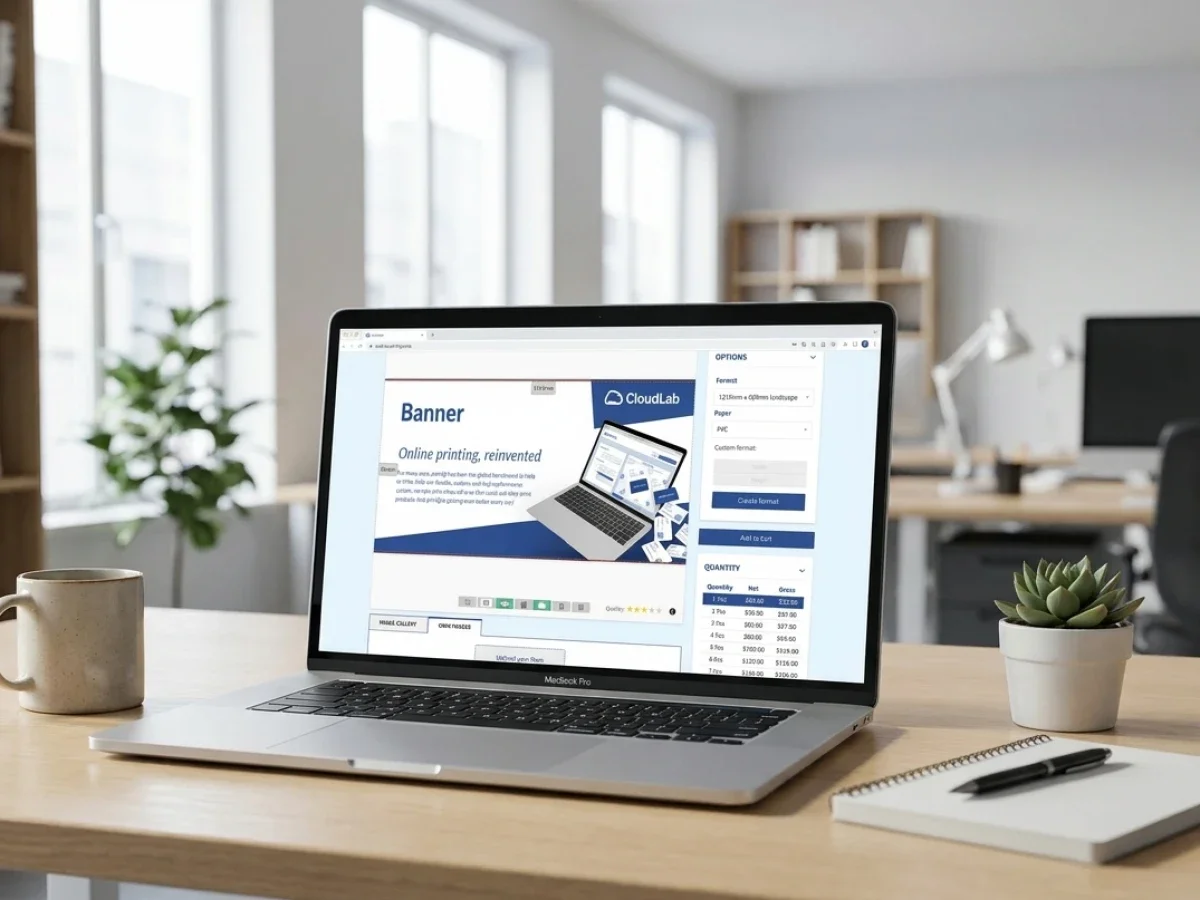
Web to Print Software for Sustainable Print

Web to print software plays a key role in making print production more sustainable. By automating workflows, reducing errors, and enabling precise ordering, modern web to print shop software like printQ minimizes waste and energy consumption. Built on Adobe Commerce, printQ connects storefronts, production, and ERP systems in one scalable environment. The result is greater efficiency, lower resource usage, and measurable environmental impact improvements.
Web to Print Software and Sustainability in Modern Print Production
Web to print software is no longer just a sales tool. It has become a structural lever for environmental responsibility in the print industry. Sustainability in print is not achieved through paper selection alone. It depends on how intelligently orders are processed, how efficiently production is organized, and how precisely customers configure their products.
Manual workflows, email approvals, and repeated corrections create waste. Every misprint consumes paper, ink, energy, and time. Modern web to print shop software eliminates these inefficiencies at the root.
printQ demonstrates how digital storefront technology and production automation combine to create more sustainable print operations.
Why Sustainability Requires Structural Change
Environmental improvements in print are often discussed in terms of recycled paper or eco inks. These are important, but they address only part of the equation.
Real sustainability depends on three structural factors:
- Reduction of errors before production
- Automation of repetitive processes
- Optimized production planning through system integration
Web to print software influences all three.
When orders are digitally configured, automatically preflighted, and transferred directly into production systems, resource waste drops significantly. Sustainability becomes operational, not symbolic.
Web to Print Software as a Resource Optimization Engine
Sustainability starts before the press runs.
When customers upload incorrect files via email, prepress teams manually adjust formats, fix color profiles, or correct bleed settings. Each manual step introduces risk.
printQ integrates automated preflight checks and production ready PDF generation. Files are validated immediately after configuration. Bleed, color profiles, and cut marks are generated automatically.
This leads to:
- Fewer rejected jobs
- Fewer reprints
- Lower paper consumption
- Reduced machine downtime
The ecological effect is measurable.
Digital Storefronts Reduce Overproduction
Traditional print procurement often relies on bulk ordering to reduce unit cost. This leads to stockpiling and waste.
Modern web to print shop software enables print on demand logic. Customers order exactly what they need, when they need it.
printQ supports both B2C storefronts and closed B2B portals in one system. Businesses can provide decentralized teams with access to approved templates. Local managers personalize materials without overordering generic stock.
The result is lower inventory waste and more targeted production runs.

Adobe Commerce Integration and Sustainable Commerce
printQ is the only web to print software built directly on Adobe Commerce. This matters for sustainability.
Magento based commerce provides advanced pricing rules, shipping logic, and inventory management. These features allow print providers to optimize delivery routes, consolidate shipments, and reduce unnecessary transport emissions.
Because commerce and production are integrated, sustainability decisions can be embedded into pricing and product logic.
For example, eco friendly paper options can be positioned intelligently within product configurators without requiring separate systems.
Automation as the Core of Sustainable Print
Automation: Sustainable production depends on reducing human intervention where it creates waste.
printQ enables lights out workflows from order to production. Once a customer completes configuration, the system generates print ready files and transmits job data via REST, SOAP, XML, JDF, CSV, or JSON to ERP and MIS systems.
This eliminates redundant manual data entry. Errors decrease. Production becomes predictable.
Energy consumption per job drops when machines operate with optimized scheduling instead of reactive corrections.
Sustainable Design Through the Online Editor
The online editor is not just a customer convenience. It is a sustainability tool.
printQ provides a browser based WYSIWYG editor with live 2D and 3D previews. Customers see exact layout positioning, finishing simulations, and alignment before submitting.
Automatic vectorization improves file quality. Varnish and embossing effects can be simulated digitally.
When customers understand the final output visually, design mistakes decrease. Fewer test prints are required. Less material is consumed in the correction phase.
Template Gallery and Variable Data Printing
Mass customization often increases efficiency rather than reducing it.
With printQ, providers create standardized templates in a template gallery. Customers personalize content within predefined design rules.
Variable Data Printing enables large scale personalization without individual layout adjustments.
This improves sustainability in several ways:
- Eliminates redundant design production cycles
- Prevents layout errors in repetitive orders
- Reduces approval loops in corporate environments
Franchise networks can produce localized materials without each branch redesigning from scratch. Consistency saves time and resources.
B2B Portals and Decentralized Sustainability
Corporate sustainability programs increasingly demand transparency in procurement.
Closed B2B portals built with printQ allow central marketing teams to control materials, formats, and production parameters. Local branches personalize only predefined elements.
This reduces rogue print jobs and inconsistent suppliers.
Centralization ensures that sustainable paper options, certified suppliers, and optimized production settings are used consistently across the organization.
Sustainability becomes enforceable through system architecture.
SaaS or On Premise for Sustainable IT Strategy
Infrastructure choices influence environmental impact.
printQ can operate as SaaS in the cloud or on premise in local data centers. Organizations choose the model that aligns with their sustainability strategy.
Cloud hosting can optimize server efficiency through shared infrastructure. On premise deployments allow enterprises to integrate with existing energy optimized environments.
Flexibility ensures that digital sustainability aligns with corporate IT policies.
API First Architecture and Waste Reduction
Open systems prevent duplication.
printQ follows an API first, headless approach. Frontend and backend are decoupled. ERP, MIS, and warehouse systems communicate directly.
When data flows automatically between systems, manual spreadsheet handling disappears.
Redundant data storage decreases. Order processing time shortens. Production planning becomes data driven.
Operational waste reduction is not abstract. It is a byproduct of technical integration.
Multi Client Environments and Efficient Resource Allocation
Agencies and print groups often manage multiple brands.
printQ allows hundreds of storefronts within one installation. Shared backend logic avoids duplicated infrastructure.
White label portals can operate without creating isolated technical environments for each client.
This reduces server redundancy and simplifies maintenance. Efficient system architecture contributes indirectly to sustainability by reducing unnecessary digital overhead.
Case Insight: SAXOPRINT and Scalable Efficiency
SAXOPRINT manages complex product portfolios at scale.
Large volumes require optimized production planning. printQ supports this through structured product configuration and automated workflow integration.
When operations scale without proportional staffing growth, resource efficiency improves. Sustainable processes depend on scalable automation.
Case Insight: Druckhäusle and Digital Transformation
Druckhäusle transitioned from traditional workflows to digital storefront operations using printQ.
By automating routine orders, the company reduced manual prepress interventions. Error rates decreased. Production cycles shortened.
Sustainability emerged as a side effect of operational modernization.
Case Insight: Velocity Graphics and Controlled Customization
Velocity Graphics implemented a closed B2B portal for a nationwide restaurant chain.
Large format menu boards were personalized locally within strict brand rules. Central templates prevented layout errors.
Fewer design corrections meant fewer test prints. Efficient workflow reduced material waste.
Sustainability was achieved through structure, not slogans.
Sustainable Scaling Through End to End Automation
Growth often increases environmental impact when processes remain manual.
printQ scales from a single storefront to hundreds of multi client portals without replicating backend systems.
End to end automation ensures that increased order volume does not proportionally increase waste.
Production ready PDFs, automated job ticket creation, and integrated shipping logic maintain efficiency even at scale.
Sustainable growth requires systems that scale intelligently.
Transparency and Reporting Potential
Modern enterprises require sustainability metrics.
Because printQ integrates with ERP and MIS systems, production data can be analyzed centrally.
Paper consumption, job frequency, reprint rates, and production cycles can be monitored systematically.
Data transparency enables strategic improvements.
Web to print software becomes a measurement tool for environmental performance.
printQ as a Premium Sustainable Infrastructure
printQ positions itself as a premium web to print software solution built on Adobe Commerce.
Its unique Magento integration provides enterprise commerce features without external modules.
Its open API structure prevents vendor lock in.
Its unified B2B and B2C capability reduces technical fragmentation.
More than 1000 live portals globally demonstrate operational reliability.
Sustainability depends on reliability. Systems that fail create rework and waste.
The Broader Impact of Web to Print Shop Software
Environmental responsibility in print is often misunderstood as material substitution.
In reality, the largest sustainability gains come from process optimization.
Web to print shop software digitizes order capture, validates files automatically, and connects directly to production.
Each eliminated correction, each avoided reprint, and each optimized shipment reduces environmental impact.
Technology becomes the silent enabler of sustainability.
Cultural Change Through Digital Workflows
Sustainability is also behavioral.
When customers interact with intuitive configurators and see precise previews, they make more informed decisions.
When corporate users access approved templates in closed portals, they follow structured processes.
Digital systems guide responsible behavior without requiring constant supervision.
printQ embeds sustainability into everyday workflows.
Web to Print Software as a Sustainability Driver
Web to print software is not just a commerce platform. It is a sustainability engine for modern print operations.
CloudLabs printQ combines Adobe Commerce integration, automated preflight, API driven production connectivity, and scalable multi client architecture in one unified system. By reducing errors, minimizing reprints, optimizing inventory, and enabling data transparency, it transforms environmental responsibility into operational logic.
For print providers, agencies, and enterprises seeking measurable ecological improvements, web to print software powered by printQ offers a practical path toward efficient and sustainable growth.
Web to print software is redefining sustainability in the print industry. By automating workflows, reducing reprints, and integrating storefronts with ERP and production systems, printQ minimizes resource waste at scale. Built on Adobe Commerce and designed for B2B and B2C environments, this premium web to print shop software enables efficient, data driven, and environmentally responsible print operations. Sustainable growth starts with intelligent systems.